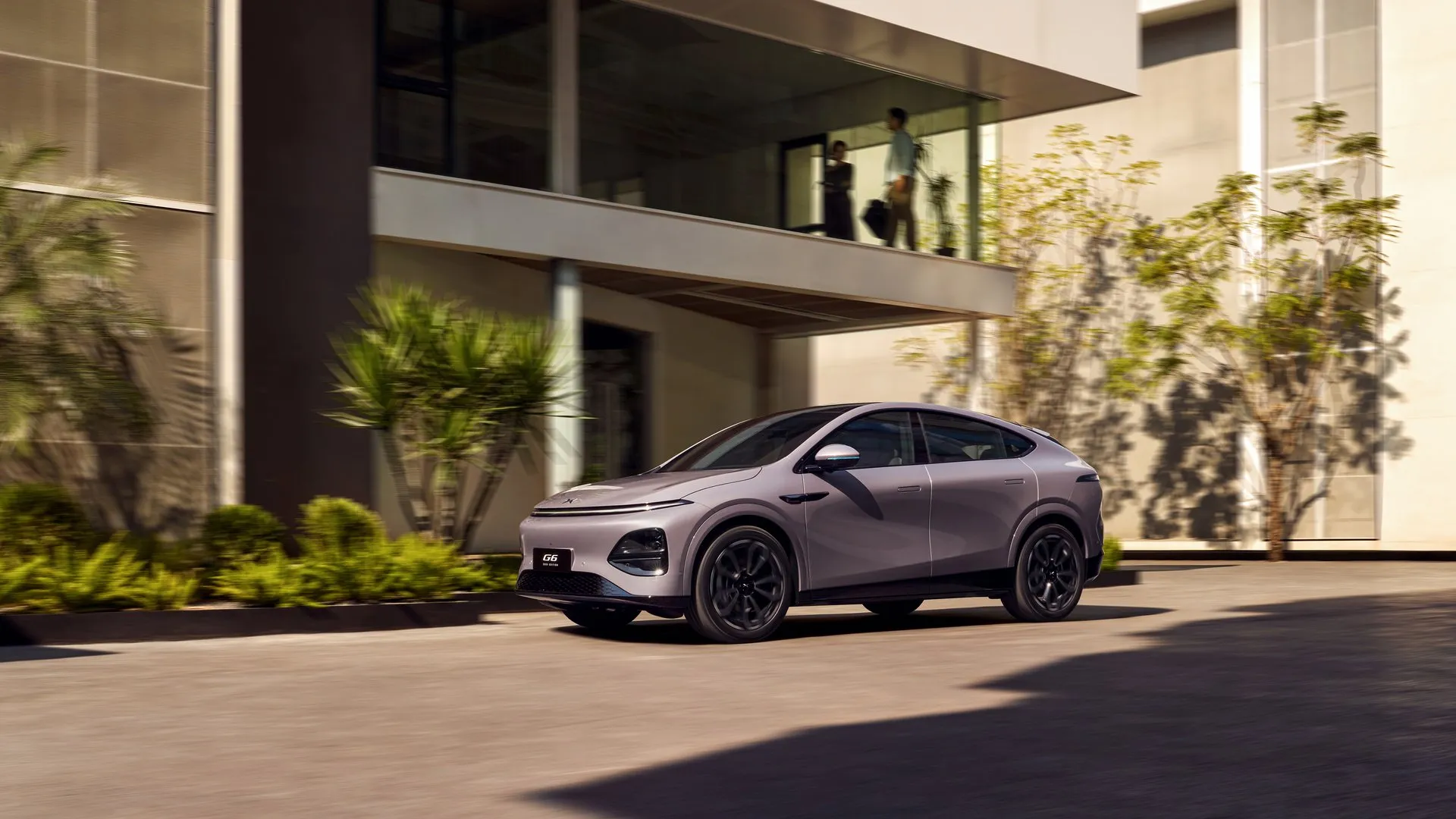
XPENG makes its EV experience smarter by combining fast charging, connected cabin software, driver-assistance hardware, energy management, and OTA updates in the same vehicle platform. The 2026 New G6 in Australia offers up to 525 km WLTP range, 451 kW peak DC charging on 80.8 kWh versions, and a 10–80% charging time of 12 minutes under specified conditions. The cabin uses a 15.6-inch central display, 10.25-inch instrument screen, “Hey XPENG” voice control, Apple CarPlay, Android Auto, and app connectivity. XPILOT Assist adds adaptive cruise, lane-centering, collision warnings, parking functions, and driver monitoring.
The experience starts with the electrical system rather than the dashboard. The New G6 uses an 800V silicon-carbide architecture and LFP batteries, with the RWD Long Range and AWD Performance versions carrying an 80.8 kWh gross battery. Their peak DC charging rate reaches 451 kW, while the 68.5 kWh Standard Range version reaches 382 kW. All three are listed at 12 minutes for a 10–80% DC session when charger output, battery temperature, state of charge, and other conditions allow it. A 70-percentage-point battery increase in 12 minutes changes how a motorway stop can be planned compared with EVs that need 25–35 minutes for the same charging window.
XPENG also reports that the G6 RWD Long Range can gain up to 427 km of charge in 15 minutes in its internal testing. That figure should not be treated as a fixed result for every public charger, because charging power normally changes during a session and outside temperature affects battery acceptance. The useful engineering detail is the combination of high-voltage hardware, a 5C battery design, and thermal management rather than the peak charging number alone.
A 451 kW peak does not say that the battery receives 451 kW continuously. XPENG states that actual DC charging time can change with ambient temperature, initial state of charge, battery condition, vehicle condition, and charger type.
Range gives another measurable view of the system. In the current Australian configurator, the RWD Long Range is rated at 525 km WLTP on 20-inch wheels, while the AWD Performance is rated at 510 km. The Standard Range reaches 480 km on 18-inch wheels or 470 km with 20-inch wheels. Listed energy consumption is 17.9 kWh/100 km for the Long Range, 18.4 kWh/100 km for the AWD Performance, and 16.6 kWh/100 km for the Standard Range on 18-inch wheels.
Those figures also show why software cannot be separated from basic vehicle engineering. The New G6 has a drag coefficient of 0.248 Cd, and wheel choice alone changes the Standard Range WLTP figure by 10 km. Route speed, passenger count, cabin cooling, outside temperature, terrain, and vehicle load can move real consumption away from the official cycle, so the navigation and battery-estimation systems have to work with changing conditions rather than one advertised range number.
For Australian buyers comparing XPENG electric cars australia, that relationship between charging time and consumption is more useful than looking at battery capacity in isolation. A car rated at 525 km WLTP but slow to recharge behaves differently on a 900 km trip from one capable of adding a large amount of energy during a short stop. XPENG pairs CCS2 DC charging with 11 kW AC charging, giving owners separate options for rapid highway charging and slower overnight charging.
Cabin software handles a different part of daily use. Current Australian New G6 specifications list a 15.6-inch central touchscreen and a 10.25-inch digital instrument display, together with Apple CarPlay, Android Auto, smart navigation, an app store, connected network services, OTA updates, Bluetooth phone-key access, NFC card-key access, and automatic phone-based unlocking. The result is fewer separate interfaces for navigation, media, access, climate settings, and vehicle configuration.
The phone-key system also changes a routine interaction that happens several times a day. Bluetooth access can identify an authorised phone near the vehicle, while the NFC card provides a separate access method. Welcome Mode and stored settings can prepare parts of the cabin before the trip begins. None of those functions adds range or power, but by 2026 vehicle software is being judged partly by how many routine inputs it can remove without making basic controls difficult to find.
Voice operation extends that idea while the car is moving. “Hey XPENG” is included in the Australian specification, allowing supported vehicle and infotainment functions to be accessed without working through several touchscreen layers. Voice interaction is particularly relevant when a 15.6-inch screen carries many functions: the screen provides visual depth when parked, while spoken commands can reduce the amount of visual interaction required during a journey.
| System | Australian New G6 specification | Everyday use |
|---|---|---|
| Central display | 15.6 inches | Navigation, media and vehicle controls |
| Driver display | 10.25 inches | Speed and trip information |
| DC charging | Up to 451 kW | 10–80% in 12 minutes on supported versions |
| WLTP range | Up to 525 km | Fewer planned charging stops |
| V2L | Up to 6 kW on listed versions | External electrical equipment |
| Boot capacity | 571 L | 1,374 L with rear seats folded |
The assistance package is more substantial than a single adaptive-cruise function. The current Australian New G6 specification lists adaptive cruise control, lane centring, adaptive turning control, forward collision warning, autonomous emergency braking, traffic-sign recognition, blind-spot detection, door-opening warning, lane-departure warning, emergency lane keeping, lane-keeping assistance, rear collision warning, rear cross-traffic alert, and driver-state monitoring. Some variants also list Auto Lane Change.
Parking uses the same camera-and-computing approach at lower speeds. Available equipment includes a surrounding-view system, enhanced automatic parking assistance, automatic exit assistance, remote parking or summon functions on specified versions, and a transparent-chassis view. XPENG states that parking assistance must comply with Australian road rules and that the person in the driver’s seat remains responsible for safe and lawful vehicle operation.
XPENG describes XPILOT Assist as an assistance system rather than autonomous driving. Its Australian material states that the system cannot handle every traffic, weather, or road condition, including poor visibility, slippery surfaces, difficult mountain roads, and some highway exits.
That limitation matters when comparing software features because a longer equipment list does not remove supervision requirements. XPENG says its broader XPILOT development uses multiple perception methods and 3D detection, while its Australian website refers to 100,000 km of daily simulation across the development process. Simulation lets engineers expose software to far more traffic situations than a single test fleet could encounter during one normal day, although simulated distance is not the same as verified kilometres on public roads.
Mechanical behaviour still determines whether electronic assistance feels natural. The New G6 uses front double-wishbone suspension and rear five-link independent suspension, with ventilated disc brakes front and rear. The RWD Long Range produces 218 kW and 440 Nm and reaches 100 km/h in 6.7 seconds. The AWD Performance raises output to 358 kW and 660 Nm, cutting the stated 0–100 km/h time to 4.13 seconds. XPENG notes that acceleration results can vary with battery charge, battery temperature, road conditions, and other factors.
Software therefore sits on top of physical limits rather than replacing them. Lane assistance can command steering corrections, but suspension geometry and tyres still determine how the vehicle responds. Traction software can control motor torque many times during a manoeuvre, but available tyre grip still changes with water, temperature, and road surface. The same relationship applies to regenerative braking, stability control, acceleration, and parking assistance.
OTA support gives the software side a longer service life. XPENG lists over-the-air updating as part of the New G6 connectivity package, allowing compatible software functions to be revised without treating every change as a workshop visit. By the 2025 and 2026 model years, OTA capability had become relevant for infotainment interfaces, voice functions, maps, vehicle settings, and supported assistance features across modern EVs.
Updates cannot upgrade physical hardware that is not installed, so a software release cannot add a missing camera, larger battery, stronger motor, or new charging electronics. Regional approval also affects feature availability. XPENG repeatedly notes that specifications can differ by market, and Australian road rules can restrict the way certain assistance or remote-parking functions are used.
Practical cabin design completes the technology package. The New G6 seats five people and provides 571 litres of luggage capacity, rising to 1,374 litres with the rear seats folded. The RWD Long Range has a listed kerb weight of 2,115 kg, while the AWD Performance is 2,220 kg. Both have a 5.8-metre turning radius and a stated top speed of 202 km/h. Those numbers put software, charging and acceleration inside the dimensions and weight of a vehicle intended for normal family and commuting use.
A smart EV experience is therefore measurable in minutes, kilometres, kilowatts, screen interactions, assistance coverage, and software support. For the 2026 New G6, the most useful figures are 525 km WLTP range, up to 451 kW DC charging, a specified 12-minute 10–80% session, 358 kW maximum output, 571 litres of standard boot space, two cabin displays, multiple parking functions, and OTA connectivity. Each figure describes a separate part of ownership; their usefulness depends on how consistently the systems work together during commuting, motorway travel, charging, parking, and everyday cabin use.