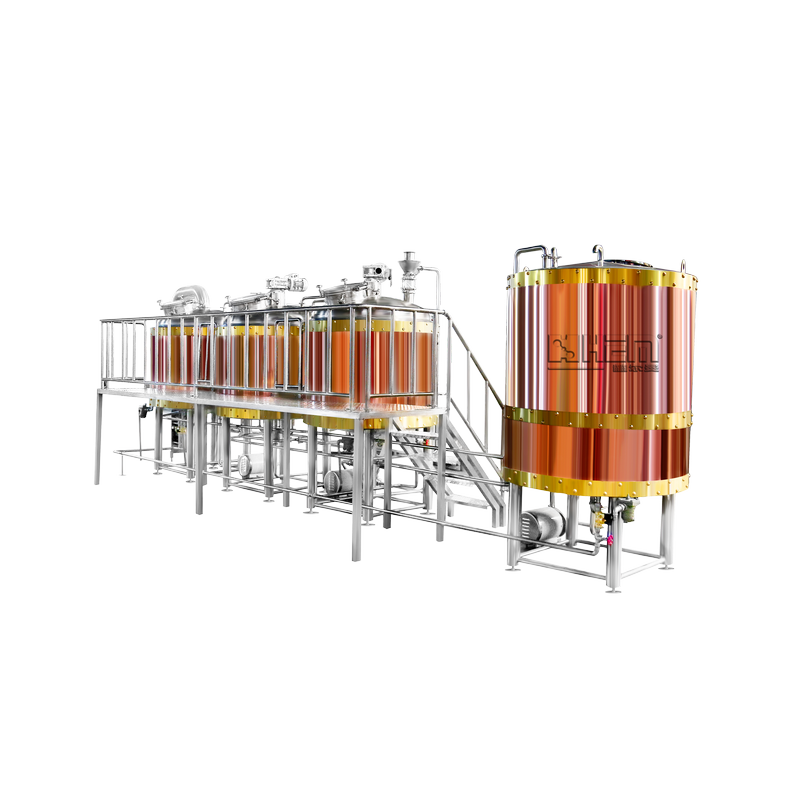
Beginners should size craft beer equipment around production volume, fermentation time, utilities, and packaging rather than tank price alone. A 500 L brewhouse running four batches per week produces about 2,000 L of wort, while 14–21 days of fermentation can require 4,000–6,000 L of tank capacity before conditioning is included. Fermenters normally need 15–25% headspace, so a 500 L working batch may require a vessel rated above 600 L. Buyers should also verify 304 or 316 stainless steel, cooling capacity, pressure ratings, sanitary welds, electrical service, drainage, CIP access, spare parts, and installation costs before placing an order.
A beginner should first calculate how much beer must leave the brewery each week, then work backward through fermentation and brewing. A 1,000 L brewhouse used three times per week can produce roughly 3,000 L of wort, but beer occupying fermenters for 18 days can require close to 8,000 L of available fermentation space when production overlaps. Adding 20% scheduling room prevents one slow fermentation from stopping the next brew.
Brewhouse size therefore tells only part of the story. A system with a large kettle and too few fermenters may spend much of the week idle, while a smaller brewhouse paired with enough tanks can run more consistently. In a 2026 brewery project, for example, comparing weekly output, tank residence time, and packaging frequency is more useful than comparing two vessels only by their nominal liter rating.
A tank labeled “1,000 L” should not automatically be treated as 1,000 L of beer capacity. Fermentation foam, dry hopping, yeast movement, and pressure control require free space above the liquid.
For many ale fermenters, allowing roughly 15–25% free space is a practical planning range, although vessel geometry and brewery procedures change the exact figure. A brewery filling 1,000 L per batch may therefore choose a fermenter with roughly 1,200 L or more of total internal volume. Ask the manufacturer whether the quoted number describes total volume, working volume, or recommended fill volume before comparing prices.
Material specifications deserve the same attention. 304 stainless steel is widely used for brewery tanks and contains roughly 18% chromium and 8% nickel, while 316 stainless generally includes molybdenum for better resistance in more corrosive environments. Material grade alone does not guarantee a good tank; internal finish, weld treatment, passivation, gasket materials, and sanitary construction determine how easy the equipment is to keep clean.
A beginner comparing suppliers can use a short specification sheet rather than relying on product photos:
| Item | Practical range or question |
|---|---|
| Fermenter free space | About 15–25% above normal fill volume |
| Stainless steel | Commonly 304; 316 where added corrosion resistance is needed |
| Fermentation pressure | Confirm rated working and test pressure in writing |
| Cooling | Check jacket area and chiller capacity at peak use |
| Internal finish | Ask for surface-finish specification and weld treatment |
| Electrical supply | Confirm voltage, phase, frequency, and total connected power |
The pressure rating deserves written confirmation because a fermenter, bright tank, and atmospheric vessel are not interchangeable. A tank expected to carbonate beer may operate around 1–2 bar in many small brewery setups, but its allowed pressure must come from the manufacturer's engineering documentation, relief-valve specification, and local requirements. Never assume that a vessel with a pressure gauge is designed for pressure service.
Temperature control is the next part to examine because fermentation produces heat while the brewery is trying to maintain a narrow temperature range. Many ales are fermented around 18–22°C, while numerous lager processes use substantially lower temperatures. A chiller that handles one tank comfortably may struggle when 4 or 6 tanks are fermenting or cold-crashing at the same time.
Cooling should therefore be sized for simultaneous demand rather than total tank liters alone. Dropping 1,000 L of beer from fermentation temperature to near 2–4°C requires far more cooling over a short period than simply holding the same tank at fermentation temperature. Ask the supplier to state the assumptions behind the chiller calculation: ambient temperature, glycol temperature, tank quantity, crash-cooling time, insulation, pump flow, and future tank additions.
“A 5 hp chiller is enough for this brewery” is not a useful specification unless the calculation states what temperature, how many vessels, and how many hours were assumed.
Heating requires the same level of checking. Electric brewhouses can be practical at smaller scales, but a building with limited electrical service may need expensive upgrades. Steam systems can heat larger vessels efficiently but require a boiler or steam generator, piping, safety hardware, ventilation, and trained servicing. Before ordering in 2026, record the site's actual voltage, phase, available amperage, gas supply, water pressure, floor drains, and ventilation conditions.
Cleaning should influence tank selection before automation features do. Product-contact areas need smooth surfaces, drainable pipework, sanitary fittings, removable or cleanable valves, and spray coverage that reaches the entire vessel. A Brewers Association water guide reported that beer is about 95% water and cited an average of roughly 7 barrels of water used for every barrel of beer produced, with much of the additional water going to cleaning and processing.
That water figure also changes the way a beginner should plan drains and wastewater. The same Brewers Association material reported that around 70% of incoming brewery water may leave as effluent, so a small brewery producing 10 barrels of beer does not have only 10 barrels of liquid to manage. Cleaning water, rinse water, floor wash, and process losses can create much larger daily flows than finished beer volume suggests.
Water use varies greatly by brewery size and operating practice. A 2015 Brewers Association benchmarking report showed median water use of 13.1 barrels per barrel of beer for participating breweries below 1,000 barrels per year, compared with 4.5 barrels per barrel among participating breweries producing more than 100,000 barrels annually. The sample sizes were 16 and 12 breweries respectively, so the numbers work better as planning references than universal targets.
Those figures make cleaning equipment, hose layout, hot-water capacity, and drain placement part of equipment purchasing rather than building details added later. A tank located 20 meters from the cleaning station may require longer hoses, more rinse water, and more handling than the same tank installed beside a well-planned utility manifold. Floor slope and drain position also affect how much manual washdown work is needed after each brewing day.
Automation should then be judged by labor saved and serviceability. A beginner does not always need fully automated valves, recipe control, or remote monitoring. Temperature probes, pump controls, timers, and reliable variable-speed drives may cover most needs in a small plant. If an automated system reduces a 6-hour brew day by 10% but replacement components require several weeks to obtain, the operational benefit may be smaller than it appears.
Ask what brands are used for PLCs, temperature sensors, solenoid valves, pumps, variable-frequency drives, and touchscreen panels. Components that can be purchased from established industrial suppliers are generally easier to replace than proprietary parts. Request an electrical drawing, I/O list, spare-parts list, and controller backup before commissioning; receiving these documents in 2026 is far easier than trying to reconstruct the control system after a component fails years later.
Packaging should be included in the original equipment calculation because finished beer must leave tanks fast enough to free fermentation and bright-beer capacity. A small keg-focused brewery may package several hundred liters with modest equipment, while a brewery filling 3,000–5,000 L per week into cans needs more labor, rinsing, CO₂ management, labeling, date coding, and cold storage.
Package loss also changes saleable volume. If a brewery starts with 1,000 L and loses 5% through yeast removal, transfers, samples, filtration, and packaging, only about 950 L remains for sale. A process losing 10% leaves about 900 L. Tank planning based only on wort volume can therefore overstate finished output by dozens or hundreds of liters per batch.
A practical purchasing comparison can separate required equipment from optional equipment:
-
Brewhouse vessels sized to actual batch volume, with about 10–20% room for process variation where appropriate.
-
Fermenters sized by weekly production and average tank occupancy rather than by brewhouse size alone.
-
Glycol chilling calculated for simultaneous fermentation and cold-crash demand.
-
Hot-water storage sized for brewing plus cleaning rather than mash water alone.
-
Pumps selected by required flow, head pressure, temperature, and product-contact use.
-
Packaging equipment matched to weekly packaged volume and available labor.
-
Spare gaskets, seals, temperature probes, pump components, and valve parts kept on site.
Facility dimensions need checking before any of those items ship. A 3-meter-tall fermenter may physically fit under a 3.5-meter ceiling but still lack enough clearance for lifting fittings, installing a spray device, or servicing top-mounted components. Door height, forklift access, floor loading, drains, columns, ceiling pipes, refrigeration lines, and a service clearance of several hundred millimeters can all affect the usable layout.
Future additions should also be included in utility sizing. Installing a glycol system with 15–25% spare capacity may cost more initially, but replacing an undersized chiller after adding several fermenters can require new piping, controls, pumps, and electrical work. The same approach applies to electrical panels, hot-water systems, compressed air, CO₂ distribution, and floor space.
Supplier evaluation should use documentation rather than a quotation total. Request fabrication drawings, tank dimensions, material certificates where required, pressure-test information, surface-finish specifications, utility loads, component brands, manuals, warranty terms, commissioning scope, lead time, shipping dimensions, and an itemized list of equipment excluded from the quote. A price difference of 10% can disappear quickly if one supplier includes pumps, platforms, valves, controls, and commissioning while another does not.
Service after installation also deserves attention. Ask how quickly the supplier normally answers technical questions, which spare parts should be stocked, whether remote troubleshooting is available, and whether common components can be sourced locally. Companies such as hem brewing can be compared with other equipment suppliers using the same written checklist, so the comparison remains focused on specifications, installation requirements, and support rather than marketing claims.
The final budget should extend well beyond tanks. Freight, rigging, glycol piping, electrical work, drainage, water treatment, ventilation, platforms, hoses, lab instruments, chemicals, keg washers, fillers, compressors, CO₂ equipment, and commissioning can add a substantial percentage to the equipment quotation. A beginner budgeting only the purchase price can therefore run out of capital before the first commercial batch is packaged.
A useful worksheet separates the equipment quote from installed cost. If tanks and the brewhouse total $120,000, adding even 25% for freight, utilities, installation, and supporting equipment raises the project to $150,000; a 40% addition takes it to $168,000. Actual percentages vary widely by site, so utility surveys and contractor estimates should be collected before the purchase contract is signed.
Production planning should end with a simple capacity check: weekly wort produced, average fermentation days, usable fermenter volume, conditioning time, packaging rate, cold-storage capacity, and expected product loss. When those numbers agree, equipment size becomes easier to justify. When they do not, increasing brewhouse capacity alone usually does not fix the mismatch.