A first fragrance order is not one decision but about a dozen, and most of them arrive earlier than a new brand expects. The order starts with the enquiry and the brief, moves through sampling and pack selection, and only then reaches production, testing and freight. Brands that treat the first half as a conversation and the second half as logistics usually discover that the decisions with the longest consequences were made casually in week two. This walkthrough sets out each stage in order, with the choice it forces and the cost of leaving it late.
Key takeaways
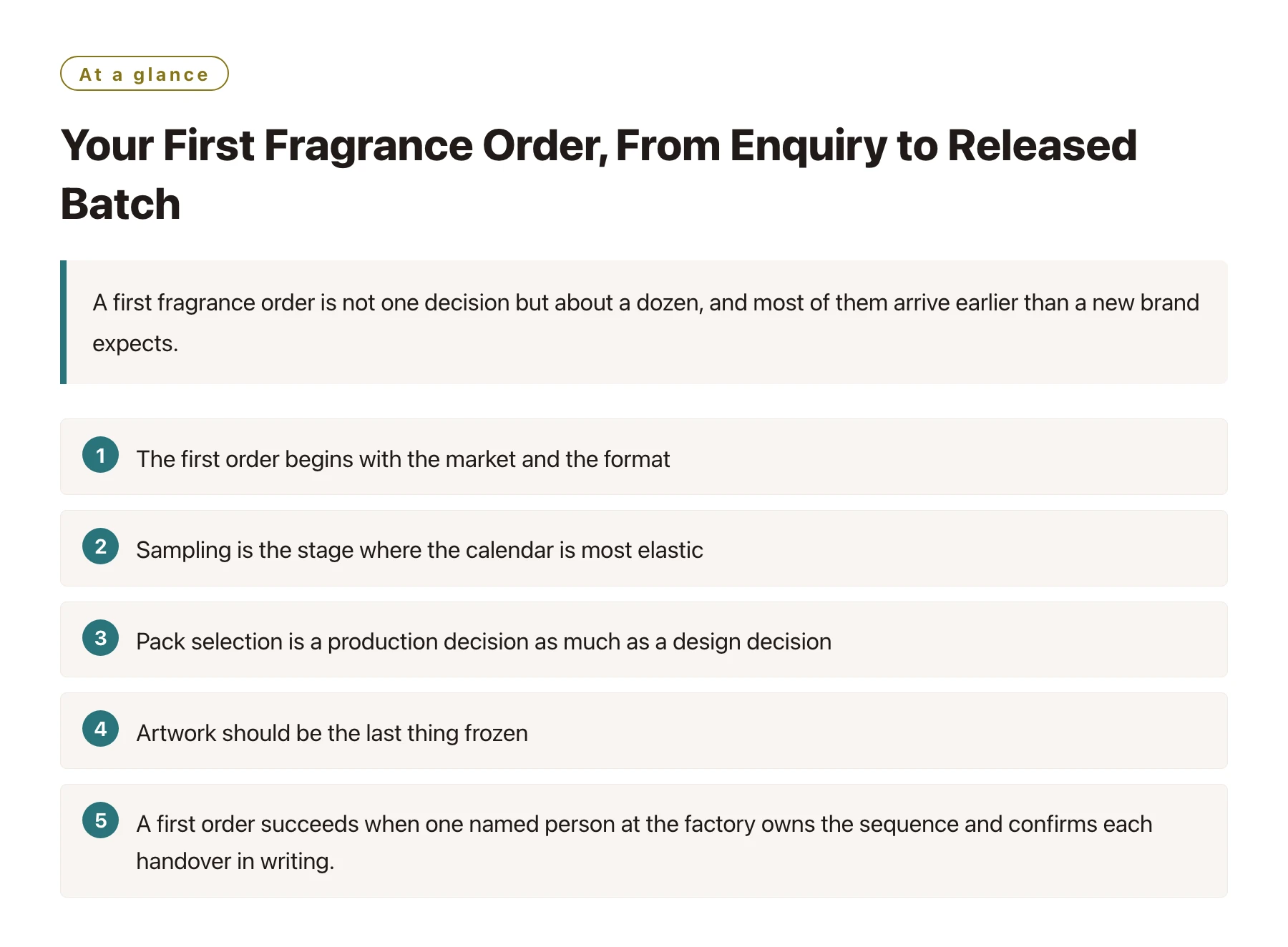
- The first order begins with the market and the format, not with the scent, because those two answers constrain everything the factory can propose.
- Sampling is the stage where the calendar is most elastic, so agree the number of rounds and the feedback rhythm before the first sample is sent.
- Pack selection is a production decision as much as a design decision, since components determine minimum quantities, testing and decoration queues.
- Artwork should be the last thing frozen, after the labelling inputs are confirmed, because a label change after printing is the most expensive rework in the project.
- A first order succeeds when one named person at the factory owns the sequence and confirms each handover in writing.
This is written for the person running a first order inside a small brand, most likely a founder or an operations lead who is also doing three other jobs. The walkthrough follows one project from the first enquiry to a released batch, and it flags the points where a small delay becomes a large one.
Two assumptions are built in. The product will be sold in the European Union, so labelling and technical documentation are part of the order rather than an afterthought. And the range is small, in the region of two to six scents, which is the usual shape of a first launch.
Nothing here is a rule about how long something must take. Durations depend on the pack, the season and the factory. What transfers between projects is the order of the stages and the fact that each one closes a door behind it.
The order, stage by stage
- Enquiry and scopeYou describe the market, the formats, the volume band and the date. This is where a factory decides whether your project is routine or novel for its lines, so be specific about the pack even if the scent is still open.
- Brief and direction proposalThe factory proposes scent directions, usually two or three per brief. Approve directions rather than bottles at this stage; approving a direction commits you to a development path, not to a final product.
- First sample roundSamples arrive with a description of the direction. Evaluate them on skin and on paper, and return consolidated feedback rather than a collection of opinions from the whole team.
- Second round and selectionThe chosen direction is refined and compared against the first version. Ask for a retained reference to be set aside now, because it becomes the standard for the bulk order.
- Pack selection and qualificationComponents are chosen and checked for compatibility with the formula. This is the point where minimum quantities, decoration and lead times become concrete numbers.
- Labelling inputs and artworkAllergen wording, required statements and net quantity are confirmed, then artwork is prepared and approved. Nothing should be sent to print before this step is closed.
- Bulk production and fillingThe concentrate is compounded, the batch is filled and packed, and in-process checks run through the shift. Request the batch record and the fill values at release.
- Quality release and documentationThe batch is released against the specification, and the documents you agreed at contract stage are issued. This is also the moment to confirm that the specification revision matches the one behind your assessment.
- Freight and arrivalGoods move by the mode you chose, with the documents travelling alongside. Check the cartons and the units against the approved sample on arrival, and keep a box for reference.
What each stage decides and what lateness costs
| Stage | Decision it closes | Cost of deciding late |
|---|---|---|
| Scope | Market, format and volume band | A factory quotes a different product and the comparison resets |
| Brief | Scent direction and reference standard | An extra sample round and a longer review cycle |
| Pack selection | Components, minimums and decoration | Tooling or decoration queues push the whole calendar |
| Labelling and artwork | What appears on the pack | Reprinting, re-approval and possible unsaleable stock |
| Bulk and filling | Batch sizes and in-process tolerances | A change means a new batch and a repeated stability question |
| Quality release | Which revision the batch was made to | A traceability gap that surfaces only when someone asks |
| Freight | Mode, route and documents | Air freight instead of sea, or a missed retail window |
The right-hand column is not a warning about the factory. Every one of these costs is avoidable by deciding in the right order, and none of them is reduced by negotiating harder at the end.
Where consumer signals enter the first order
The trends a brand reads about during planning show up in a first order as concrete requirements. Interest in refillable and lower-impact packaging changes the pack selection stage, because refill formats add compatibility and leak testing and may change the components that set the minimum quantity.
Claim scrutiny changes the labelling stage. If the brand intends to say clean, long-lasting or refillable, the evidence has to be identified before artwork is frozen, because the label and the campaign both depend on it. Packaging rules have tightened as well, and the requirements that apply to reusability and material content are now part of the design conversation rather than a post-launch concern [1]. Industry coalitions working on packaging design publish guidance that is useful when comparing components on material choice and recyclability [3].
Consumer research published by the industry shows that shoppers reward products that make a verifiable promise, and the same research shows how quickly the reward disappears when a promise is not supported [2]. For a first order, that means the safest creative position is the one you can evidence with documents the factory will actually issue.
None of this requires a large compliance budget. It requires putting the claim list in front of the factory at the brief stage and asking which claims its documentation can support, then choosing the pack and the copy accordingly.
Three habits that shorten a first order
The first habit is to consolidate feedback. One written response per round, agreed internally before it is sent, removes days from every cycle. A factory receiving five sets of comments will wait for a decision, and that waiting is invisible in a schedule.
The second is to ask for dates rather than durations. A twelve-week lead time tells you nothing about your project; a batch date tells you whether you will hit a retail window. Ask also what would move the date, and write the answer down.
The third is to keep the documentation request attached to the order rather than to the relationship. Confirm the pack in the contract, then check it on delivery. This is also how you compare options at the start: understanding the stages of perfume production makes it obvious why some quotations include testing and sampling and others do not.
If your project involves several scents, it is worth looking at the brands behind these scents to see how a small range is usually grouped across formats and volumes. The same three habits apply at portfolio level, and a grouped range moves faster than treating each scent as a separate project.
For brands sourcing production in another country, the sequence is identical and the documentation question gains weight. A partner used to contract perfume manufacturing in China for regulated markets will normally describe the handover points and the document pack without being prompted, which is a useful signal during the enquiry stage. A quick sanity check before that enquiry is to read how a manufacturer presents its own sequence, as xuelei.com does on its site.
A last piece of housekeeping that repays the effort: keep one box of the finished goods unopened and stored as your own reference. When a second order arrives months later, the fastest way to answer the question of whether it matches the first is to compare it with the first, not with a photograph.
Sources
- European Commission: Packaging Waste and the PPWR —— EU rules on packaging and packaging waste, including the Packaging and Packaging Waste Regulation requirements on recyclability and design.
- Mintel Press Centre —— Mintel's press releases on consumer and beauty market research, including fragrance and personal care trend reporting.
- Sustainable Packaging Coalition —— A membership organisation working on more sustainable packaging design, publishing material and recyclability guidance.
Frequently asked questions
How far in advance should a first fragrance order start?
Allow four to six months from the first enquiry to goods on hand for a small range with a stock pack, and more if tooling, complex decoration or peak season production is involved.
What should be decided before contacting a factory?
The market, the format and an honest volume band. Those three answers determine which projects the factory considers routine and produce a far more useful first response.
When should the pack be chosen?
Before the final formula is locked, because compatibility and stability testing are run in the finished container. Choosing the pack late can invalidate testing that has already been paid for.
Which documents should travel with the first shipment?
The batch documentation agreed in the contract, typically a certificate of analysis and the batch record reference, plus the labelling inputs your compliance file depends on.
Is it worth ordering a small first batch?
Usually yes, if the pack allows it. A small opening order tests the working relationship, the documentation and the logistics before a larger commitment, even when the unit cost is higher.
What is the most common first-order mistake?
Freezing artwork before the labelling inputs are confirmed. It is the least expensive issue to prevent and the most expensive one to correct.