Animated vs Static Characters: Choosing What You Prefer
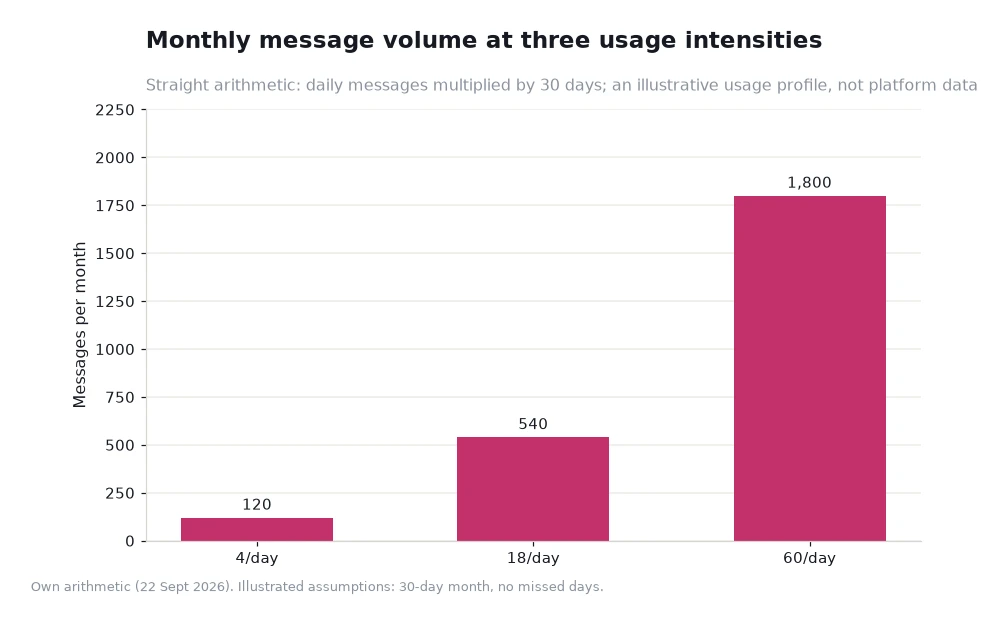
Animated and static cards are two ways of presenting the same kind of text-based character, and the choice is mostly about how you browse rather than what you get. The home page keeps a shelf called Animated beside its Recent Hits shelf, which is enough to make the question worth answering: a lighter trial habit at 4 messages a day is 120 messages a month, while 18 a day reaches 540. Which shelf you start from quietly sets that number.

Key takeaways
- Presentation changes scanning, not medium: cards marked Animated sit on their own shelf, while the conversation behind any card is AI-generated text.
- A trial habit is arithmetic. Four 20-message trials in a week is 80 messages, which is two thirds of a 120-message month at 4 a day.
- Static cards reward reading first; animated cards reward trialling first, and the two habits produce different monthly volumes.
- Presentation is a browsing fact, not a quality signal: judge a card on its description, tags and creator, then on a trial.
What actually changes when a card is animated
The first thing that changes is the order in which your eye moves. A shelf of static cards is read top-left to bottom-right, and you finish the row before you commit to anything. An animated card interrupts that sweep, because movement is what peripheral vision notices first. The practical effect is a second look at a card that might have been skipped, and a slower read of a shelf that contains several of them.
The second thing that changes is what you can compare before you open a chat. With static presentation you compare on text: the description, the tag row, the creator credit shown as "by ...". Animated presentation adds one more thing to look at, and that extra signal is a browsing aid rather than a different product. The platform's own statement describes its content as AI-generated text depicting no real person, and says the site does not produce images or video, so the Animated label tells you how characters are presented on a shelf rather than what the conversation is made of.
The third change is subtler and worth naming. Movement creates an expectation of pace. Someone who arrives from an animated shelf tends to open more cards in the same session, and someone who arrives from a static shelf reads longer before opening anything. Both habits are fine; they just lead to different months.
Where presentation styles change the habit
Static shelving favours readers who want to arrive at the right card on the first try. You read four or five descriptions, keep the tags in mind, and open one chat with a clear expectation. The volume that produces is modest by design: a few sessions a week, each with a purpose, which is the profile in the chart below that reaches 120 messages in a 30-day month.
Animated shelving favours trial-and-error. You open three or four cards for ten or fifteen messages each, drop the ones whose tone does not land, and continue with the survivor. That is faster to a good fit for some readers and slower for others, and it produces a distinctly larger message count: three 20-message trials is 60 messages, and eight is 160.
Neither pattern is a rule about anyone's taste, so treat the mapping as a description of browsing styles rather than a claim about you. The one constant is that the tag filters - Filtered, Unfiltered and 18+ - cut across both shelves. They decide what you are shown; presentation only decides how it is shown.
| Decision on the shelf | With static cards | With animated cards |
|---|---|---|
| Which card gets the first look | The one whose description reads best at a glance | The one whose presentation moves, often not the best description |
| How much you read before opening | Two or three descriptions in full | One description, then straight into a trial |
| How many cards you try in a session | Usually one, occasionally two | Three or four before a week is out |
| Typical message volume it produces | About 120 messages in a 30-day month at 4 a day | 540 at 18 a day when trials keep multiplying |
| What presentation does not tell you | Whether the writing suits you | Whether the writing suits you |
Worked example: costing two browsing habits in messages
Start with the trial itself. A trial long enough to judge tone takes about 20 messages, and at 30 seconds a message that is 10 minutes of attention. Four trials a week is 80 messages and 40 minutes; those 80 messages are two thirds of the 120-message month quoted in the chart, which means a light trialling habit sits close to the edge of the lightest intensity shown.
Now scale it. Suppose the animated shelf pushes you to eight trials in a week instead of four: 160 messages, 80 minutes, and 30% of a 540-message month at 18 messages a day. The multiplication is the same at every level, because daily count times 30 days is the definition used in the chart: 4 a day gives 120, 18 gives 540, 60 gives 1,800.
That gives a simple rule for choosing a shelf. If your weekly sessions are already near the top of the lightest band, a shelving style that encourages trials will push you into the middle band, and it is worth deciding in advance whether that is what you want. The arithmetic is illustrative, an assumption built to show the multiplication rather than a record of anyone's month.
Choose by trial, then check the shelf
Presentation is not a quality signal, so do not choose between an animated card and a static one on the strength of movement. Run the same short trial on both: 20 messages, same ground rules, then ask which one you would have continued without being nudged. Trial twice before you conclude anything, because one uneven opening exchange says more about a single reply than about a character.
When you do want a reference point, use the shelves rather than the labels. The Crushon nsfw ai list groups twenty NSFW AI characters with their view and favourite counters on the card, which is a faster way to see whether the style you like also travels well with other readers than any debate about presentation.
Then write the decision down in one line - animated shelf, four trials, keep one - and revisit it after a fortnight. A preference that survives two weeks of trialling is a preference; a preference formed on one moving card is a mood. If you want the mechanics rather than the taste, the AI chat blog walks through setup choices in the same order this article uses: filters first, then presentation, then the first session.
Frequently asked questions
Does the Animated shelf contain different characters?
It groups characters by presentation style. The conversations behind both shelves are AI-generated text, and the filters for Filtered, Unfiltered and 18+ cut across them.
Is animation a sign of a better card?
No. Movement changes which card gets a second look; it says nothing about the description, the tags or how well a character holds a longer conversation.
How long should a trial be?
About 20 messages, which is roughly 10 minutes at 30 seconds a message. Four such trials in a week produce 80 messages, two thirds of a light 120-message month.
Pick the habit first, the card second
Decide how many trials a week you want before you open a shelf, because the shelf sets the tempo and the tempo sets the month. If you prefer to read first, start from static cards and open one; if you prefer to test first, use the animated shelf and cap the trials at four. Either way the arithmetic from the chart applies: 4 a day is 120 messages a month, 18 is 540, 60 is 1,800, and knowing which band you are in is more useful than knowing which presentation style you clicked last.
Data: shelf names, filter labels and card counters as published on the Crushon home and trending pages, read 22 Sept 2026[1]. Message volumes are own arithmetic shown as an illustrative usage profile, not platform data, and no figure here is a promise of how any account performs. Content described is AI-generated text. This article is written for readers who are 18 or older.