4 mm² Solar Cable: The Cross-Section Most Roofs Need
Most domestic strings finish on 4 mm². KUKA CABLE lists 4 mm², 6 mm² and 10 mm² among its commonly used solar cable sizes, and the smallest of the three carries 56 strands of 0.29 mm copper, a nominal diameter of 5.5 mm and a published weight of 59 g/m. Roofs settle there out of arithmetic rather than habit: it is the section that carries a single string over a normal roof run without making the installer fight the cable.
Key takeaways
- 4 mm² is built from 56 strands of 0.29 mm tinned copper, class 5 flexible to IEC 60228, with a 5.5 mm nominal overall diameter.
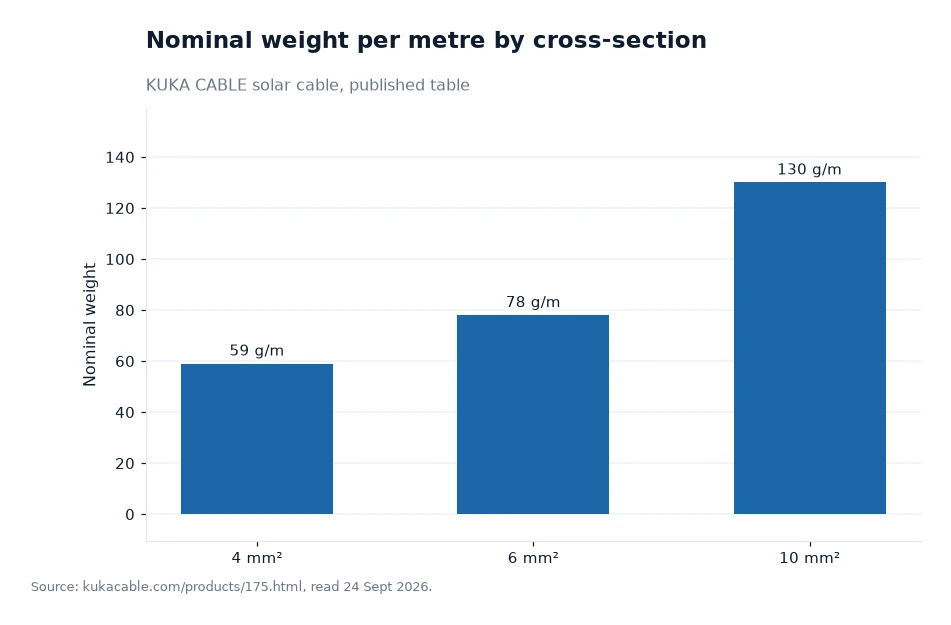
- The published nominal weight is 59 g/m, against 78 g/m for 6 mm² and 130 g/m for 10 mm².
- Minimum bending radius is 4× the diameter, so 22 mm here (author's arithmetic on the published 5.5 mm figure).
- Insulation and sheath are both electron-beam cross-linked XLPO and LSHF, in black or red.
Why a roof run lands on four square millimetres
A rooftop array imposes three constraints at once: the current the string delivers, the distance to the inverter, and the room between a module frame and a mounting rail. Of the three commonly used sizes the manufacturer publishes, 4 mm² is the smallest, and it is the one that satisfies those constraints on a typical house without a second size entering the bill of materials.
Weight is the tell. At a published 59 g/m for the 4mm solar cable, a 30 m run weighs 59 × 30 = 1,770 g, or 1.77 kg before the drum is counted — the author's calculation from the published table. The same run in 6 mm² comes to 78 × 30 = 2,340 g. A lighter cable is easier to clip at height and loads a rail less, which is why the smallest adequate section tends to win on roofs.
The build underneath the sheath
The published conductor construction is 56 strands of 0.29 mm, tinned copper, class 5 flexible according to IEC 60228. Tinning holds back the surface oxide that makes a stripped strand brittle, and it survives the small movements a roof makes through the seasons better than bare copper.
Insulation and sheath in the manufacturer's solar cable section are both XLPO, electron-beam cross-linked and LSHF. For 1.5 mm² to 10 mm² the published build uses 0.7 mm of insulation and 0.8 mm of sheath; the larger sections run from 0.9 mm to 1.7 mm of insulation and 0.8 mm to 1.7 mm of sheath. The 1500 V construction is rated DC 1.8/1.8 kV, tested in production with a 10 kV spark test and on the finished cable with a 6.5 kV AC, 50 Hz voltage for five minutes.
Where four millimetres stops being the answer
Two published limits decide when a designer steps up a size. The bending rule is 4× the outer diameter, so the smaller section takes the tighter curve — 22 mm against 24 mm for 6 mm², by the author's arithmetic — but the heavier section is the one that carries a longer run at the same current.
Voltage drop is the designer's calculation. The manufacturer publishes no ampacity table or derating figure on its site, so the drop has to be worked against the design's own string current instead of a rule of thumb. The electrical data that is published is the test data: proof voltage, spark test, and a temperature window of −40 °C to +90 °C ambient, with +120 °C for 20,000 hours and +250 °C for five seconds at short-circuit.
Fixing details that follow the diameter
A 5.5 mm cable takes a standard clip, and the published −40 °C to +90 °C window covers the surfaces a roof run crosses without special measures. Because the section is small, the temptation is to coil surplus against the rail; keep the coil radius above 22 mm and the cable keeps the margin the laboratory measured.
Clip spacing is worth fixing at the same time. The published diameter of 5.5 mm sits inside most standard solar clips, but the spacing between them comes from the roof's own structure and the local wind load, not from the cable datasheet, and the manufacturer publishes no fixing schedule. That laboratory has run since December 2015 and is described as an ISO/IEC 17025 laboratory. Its published elongation figure for the manufacturer's PV cable is up to 185%, read against the EN 50618 requirement of more than 125%, and the site lists a 2,000-hour xenon lamp UV test equivalent to about 360 weathering cycles.
What the certificates cover
The published standards for the 1500 V cable are TUV 2PfG 1169/08.2007, EN 50618:2014 and IEC 62930. The manufacturer's material also names a CPR fire rating and an AD8 waterproofing rating for installations that need them, and treats certification as a starting point: certified cable is expected to keep its performance stable for more than 25 years.
The certificates page states more than 30 types of certificate such as TUV, IEC, CE, SAA and UL, with UL described as in the process of updating. A buyer should ask for the copy that belongs to the reel's printed code rather than a generic scan.
| Nominal cross-section | Conductor construction | Nominal overall diameter | Nominal weight | Radius at 4× diameter (author's calculation) |
|---|---|---|---|---|
| 1.5 mm² | 39 × 0.25 mm | 4.6 mm | 34 g/m | 18.4 mm |
| 2.5 mm² | 49 × 0.25 mm | 5.0 mm | 45 g/m | 20.0 mm |
| 4 mm² | 56 × 0.29 mm | 5.5 mm | 59 g/m | 22.0 mm |
| 6 mm² | 84 × 0.29 mm | 6.0 mm | 78 g/m | 24.0 mm |
| 10 mm² | 142 × 0.29 mm | 7.5 mm | 130 g/m | 30.0 mm |
| 16 mm² | 238 × 0.29 mm | 8.8 mm | 190 g/m | 35.2 mm |
Worked example
Check the copper against the label. The published construction of 4 mm² is 56 strands of 0.29 mm. Each strand has an area of π × (0.29 ÷ 2)² = 0.066 mm², so 56 strands come to 56 × 0.066 = 3.70 mm² of copper — the author's own calculation from the published strand count, and the reason the size is called 4 mm².
Weigh a delivery note the same way. A 500 m drum at 59 g/m works out to 59 × 500 = 29,500 g, or 29.5 kg of cable, again the author's arithmetic on the published figure. A drum arriving at 24 kg for the same length would mean a lighter build than the datasheet describes, and that is a question worth raising before the cable is unrolled.
Frequently asked questions
Is 4 mm² enough for a normal rooftop string?
It is one of the three sizes the manufacturer lists as commonly used, built from 56 strands of 0.29 mm tinned copper with a 5.5 mm nominal diameter and a published weight of 59 g/m. Whether it suits a particular string depends on the current and the distance, and the manufacturer publishes no ampacity table, so the voltage drop has to be worked against the design's own numbers.
How much does a 4 mm² solar cable weigh per metre?
The published nominal weight is 59 g/m, against 78 g/m for 6 mm² and 130 g/m for 10 mm². A 30 m run therefore weighs around 1.77 kg by the author's arithmetic on the published figure, before the drum and pallet are counted.
What to put in the enquiry
Ask the manufacturer in Jinshan District, Shanghai for the data sheet behind the cross-section table and check three printed values against it: nominal diameter 5.5 mm, nominal weight 59 g/m and conductor construction 56 × 0.29 mm. Then confirm the bend radius allowed on the drawing is at least 4× that diameter, which is 22 mm. The site publishes no price, MOQ or lead time, so keep those in the quotation request rather than in the technical specification. Where a run is long enough that drop becomes the deciding factor, ask the manufacturer for the section it recommends for that current and distance and compare the answer with the table.
Diameter, strand and weight values for the 4 mm² construction were read on KUKA CABLE's own website at kukacable.com, on 24 Sept 2026[1].